None of the leadership teams I work with call their situation a crisis. They call it normal. There is always another fire. The same problems keep coming back in slightly different costumes. The team is capable, experienced, working hard. And the business is still not moving the way it should. Here is the uncomfortable part: firefighting used to be your superpower. In the early days, it was survival. The team was small, everyone knew everything, the founder was in the room. Problems got solved in hours. The impossible got shipped. Pulling together under pressure is how culture and confidence were built. Then the business grew. The method didn't.
What made a ten-person company fast makes a two-hundred-person company blind. And this is not a people problem. It is a design problem, with five well-documented causes. Here they are.
1. Urgency gets rewarded, importance gets neglected
In 1954, President Eisenhower shared the observation that would outlive him: what is important is seldom urgent, and what is urgent is seldom important. In 1989, Stephen Covey built it into the most famous matrix in management, in The 7 Habits of Highly Effective People. Every manager has seen it. Most can draw it from memory. And seventy years on, most organizations still run their calendars as if it were never written.
The matrix asks two questions of every task: is it urgent, and is it important. The answers sort your entire workload into four quadrants, each with a one-word rule:
Urgent and important: do. Crises, deadlines, emergencies. Handle them now. But look closer: most of them are yesterday's skipped prevention, arriving with interest.
Important, not urgent: schedule. Prevention, improvement, capability building. Covey called this the heart of effective management. It decides your future, and it does so in complete silence.
Urgent, not important: delegate. Interruptions, other people's meetings. Urgent for someone. Not for you.
Neither: delete. Busywork. It should not exist, so stop letting it.
Now the trap. Three of these quadrants fight for your attention every day. The fourth, the one with prevention in it, never rings, never escalates, never burns. It just waits. And in a firefighting organization, it waits forever, even though it is the only quadrant that can reduce the fires.
Urgency has one more weapon: it creates heroes. The person who saves the day gets seen, thanked, promoted. Soon a few people become indispensable, because only they know how to tame the recurring crisis. Look at what that means: their value now depends on the problem staying alive. Solve the root cause, and the hero has nothing left to be a hero about. Prevention is invisible. Crisis response is visible. Organizations reward what they can see.
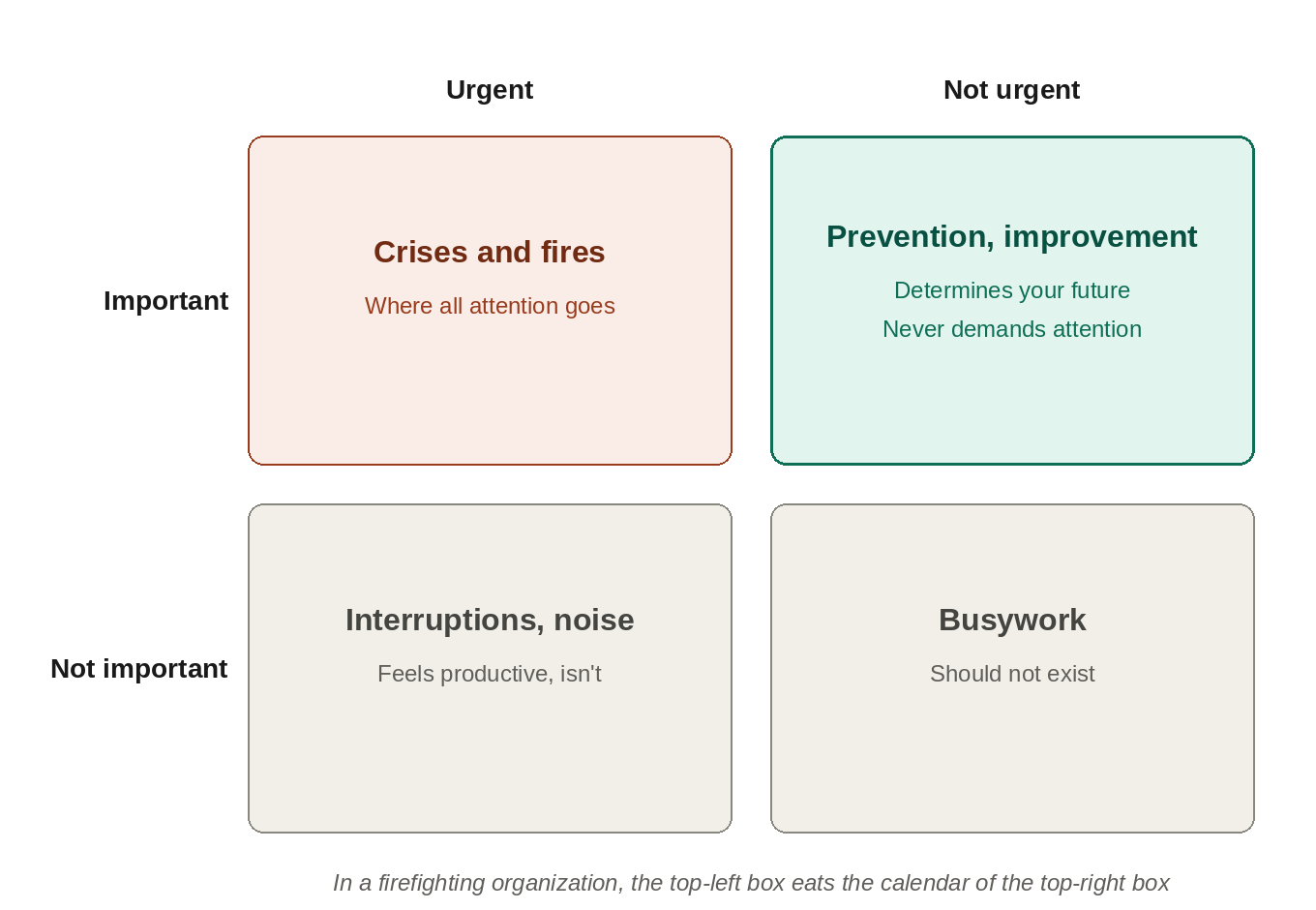
Figure 1. The urgency-importance matrix, adapted from Stephen Covey's Time Management Matrix in The 7 Habits of Highly Effective People (1989).
2. Growth outpaces structure
Every founder remembers the golden age. Ten people, one room, zero process. A customer complains at 9:00, the fix ships by lunch. Nobody writes anything down because everybody already knows. The company doesn't have communication channels; it has a coffee machine. This isn't chaos. At that size, it's a competitive weapon. Big competitors need a steering committee to change a font. You need a Tuesday. Then you hire. And hire again. And somewhere between employee 30 and employee 100, the physics quietly change. Knowledge that used to live in everyone's head now lives in three heads. Decisions that took a hallway now queue outside one office. The processes were never written down because they never needed to be, so they can't be delegated, replicated or improved. They can only be performed, live, by the people who carry them in memory.
Congratulations: your best people are now bottlenecks. When they're in the room, things move. When they're on vacation, things burn. Ask around any scaled-up company and you'll find them: the three people nobody can afford to lose, who haven't taken a real holiday in two years.
The strangest part? Nobody chose this. There was no meeting where the company decided to outgrow its own operating system. The habits that built the business simply kept running past their expiry date. Structure was never rejected. It just sat in the important-but-not-urgent quadrant. Waiting.
3. The fire is invisible until it's expensive
You are not firefighting because your people react slowly. They react fine. Everything just reaches them late. A supplier slips a few days, a cost line drifts for a quarter, a team lead says "we should look into that" and the meeting moves on. Three months later the same issues return with new names: a missed deadline, a budget hole, a Monday crisis. Nothing new happened. The old problems just got more expensive.
Why so late? Look where your operational truth lives. Supplier issues in someone's inbox. Cost overruns in a spreadsheet with one owner. Capacity risk in the head of a team lead with a bad feeling about Q4. Each signal exists. None can travel. Three anomalies that never meet can never become one visible pattern.
This isn't a small-company quirk. At Equifax, attackers operated inside the network for 76 days; an expired certificate had quietly switched off the monitoring. At Danske Bank's Estonian branch, a whistleblower report sat unactioned for three and a half years while the branch ran outside the group's line of sight. At Nokia, the middle of the organization knew the company was losing to the iPhone; the top received optimistic reports. Three industries, three disasters, one finding: someone always knew. Missing in every case was the mechanism that turns what the frontline knows into what leadership sees.
So when the CEO finally asks, "Why am I only hearing about this now?" the honest answer is uncomfortable. The information was there all along. It was sitting in an inbox, waiting to become urgent enough to travel on its own.
4. Root causes are never addressed
Every firefighting organization has a problem it has solved five times. Different month, different name in the incident report. Same problem. Why does it return? Because every problem can be solved two ways. The quick way kills the symptom: restart the server, appease the customer, ship the workaround. The complete way kills the cause. The quick way takes an afternoon. The complete way takes a week nobody has. Guess which one wins.
Toyota refused this trade. Ask "why" five times, its engineers learned: the machine stopped, because the fuse blew, because the bearing seized, because it wasn't lubricated, because the filter was clogged. Fix the fuse and it stops again next month. Fix the filter and it never stops for this reason again. Five questions separate a patch from a solution. Underneath sits a deeper failure. When procedures live only in heads, every problem arrives as a fresh mystery. No standard, no deviation. No deviation, nothing to root-cause. You can only fight it. Again.
Each patch feels like progress. The problem leaves the agenda. It hasn't gone anywhere. It's waiting in the pile of causes nobody fixed.
5. The management system never kept pace with the business
This is the root under all the other roots.
Your company owns every part of a management system. A strategy process. A risk register. Quality reviews. Financial reporting. Board meetings. Each part works. None of them work together. Each has its own meeting, its own report, its own version of the truth, and the leadership team is expected to fuse them into one picture. In their heads. It has never once happened.
The numbers say this is the norm. In Gallup's mid-2025 data, only 47% of employees strongly agreed they know what is expected of them at work. For the other half, strategy never arrives. Gallup's own diagnosis could be a sentence from this article: the business landscape has transformed, but many management systems haven't kept up. McKinsey agrees from the other direction: even strong companies lose much of their strategy's potential to a weak or outdated operating model. The strategy is fine. The pipes were built for a smaller company.
So the fires win by design. Priorities don't reach the frontline, so people choose by loudness. Risks don't travel upward, so leadership meets them as surprises. Data doesn't connect to decisions, so the same numbers get admired monthly and acted on never.
Which leads to the sentence every CEO in this situation needs to hear: your organization is not badly managed. It is configured to react. Nobody designed it that way. Nobody redesigned it either. The gap between those two sentences is where all the fires come from.
Why firefighting becomes normal
Not because people don't care. Firefighting wins because it pays immediately: fixing an urgent problem produces fast, visible results, while improving a process pays off later and may even reduce output first. Under pressure, leaders postpone the improvement, the next fire arrives before anything has changed, and the cycle locks in.
Visible failures like customer complaints then absorb all attention, while the early signals stay quiet: rising rework, ageing decisions, near misses. So leadership manages consequences instead of causes.
Add fragmented reporting lines where strategy, risk and quality each tell their own story, and a culture where bad news travels slowly, and you get the classic CEO question: "Why am I only hearing about this now?" The answer is rarely that nobody knew. The organization simply had no mechanism for the information to travel.
What to change: eight moves
Every cause above is structural, so the fix cannot be motivational. You don't talk an organization out of firefighting; you redesign the conditions that make it the rational choice.
Run one management rhythm. Separate meetings for strategy, risk, quality and operations produce separate truths, and the leadership team is left to assemble the full picture in their heads. It never happens.
Change the calendar: merge these reviews into one connected rhythm where the same priorities, risks and numbers sit on the same table.Pick 3-5 priorities per quarter. When everything is a priority, people choose by loudness, and the loudest thing is always a fire.
Change the portfolio: name the few priorities that matter, and explicitly sort everything else into delegated, postponed, or not doing. The stop-doing decision is the strategy.Give every critical outcome one owner. Shared ownership means everyone is involved and no one can decide, so problems drift until they explode.
Change the organization design: one name next to every critical priority, process and risk. Never a committee. If you can't say who owns it in three seconds, nobody does.Watch signals, not just results. Your dashboard shows fires that already happened; by then only reaction is possible.
Change the dashboard: add the quiet numbers. Rising rework. Ageing decisions. Near misses. Growing work in progress. Review them with the same seriousness as revenue.Define when work stops. Without a written rule, delivery pressure outranks risk every time, because nobody wants to be the one who paused the release.
Change the protocol: write down what must be escalated, who can pull the brake, and how fast it gets triaged. Then publicly back the first person who uses it. That moment, not the document, is when the protocol becomes real.Reward fixing, not rescuing. The person who saves a burning project gets seen, thanked, promoted. The person who prevents fires produces no drama and gets overlooked. Your reward system is training everyone to firefight.
Change what you celebrate: put prevented problems, closed root causes and stable operations into scorecards and promotions, and ask in every review not just "who saved us" but "whose area had nothing to save."Kill the toil. Manual reporting, status-chasing and recurring coordination eat exactly the capacity prevention needs. An organization with zero free capacity can only react.
Change the workload: map where management time actually goes, then automate or delete the repetitive work. But clarify ownership first. Never automate a broken process.Close every incident. Without follow-up, every fire is just an interruption, and the same fire returns wearing a different name.
Change the routine: every serious incident gets a root cause, an owner, a deadline and an effectiveness check. No exceptions. This single habit is the difference between an organization that has problems and one that learns from them.
Read the list again. No new software. No new hires. No reorganization. Eight decisions, all of them free, all of them available on Monday morning. Which is the good news and the uncomfortable news in one sentence: if the redesign is entirely within the CEO's authority, then so is the current design. The fires have an architect.
Conclusion: Firefighting is optional
Remember where this started: a capable team, working hard, and a business that is still not moving the way it should. Now you know why. The energy is real. It is just being spent on the expensive version of every problem. Firefighting is not a character flaw and not a phase. It is the method that built your company, still running long after the company outgrew it. Nobody chose it. But it can be unchosen, and the eight moves above are how: not a transformation program, not a new platform, just a series of decisions that change what gets seen, who owns what, and what gets rewarded.
The fires will not stop overnight. But one quarter of honest redesign is usually enough to feel the difference: fewer surprises, shorter Mondays, and leadership time spent on the future instead of the weekend's damage. If several of these causes sounded uncomfortably familiar, that is not a verdict on your company. It is a starting point. The redesign conversation is worth having, and the best time to have it is before the next fire, not after.
Sources
Dwight D. Eisenhower, address to the Second Assembly of the World Council of Churches, Evanston, Illinois, August 1954.
Stephen R. Covey, The 7 Habits of Highly Effective People, 1989.
Gallup, employee engagement (Q12) data, Q2 2025.
Bruun & Hjejle, independent investigation of Danske Bank's Estonian branch, 2018; US Department of Justice resolution, 2022.
US House Committee on Oversight and Government Reform, The Equifax Data Breach, 2018.
Timo Vuori and Quy Huy, "Distributed Attention and Shared Emotions in the Innovation Process: How Nokia Lost the Smartphone Battle," Administrative Science Quarterly, 2016.
Taiichi Ohno, Toyota Production System, 1988 (the Five Whys method).
McKinsey & Company, research on operating models and organizational performance.
Nelson Repenning and John Sterman, research on firefighting in product development and the capability trap, MIT Sloan.
Karina Bärg · Governance & Operating Model Architect
